Crosshair Placement
Crosshair placement is one of the most impactful skills you can develop in Counter-Strike 2.
Archived guide · Last edited 25 Mar 2026. Game details may have changed since publication.
CS2 Crosshair Placement Guide#
Crosshair placement is one of the most impactful skills you can develop in Counter-Strike 2. Unlike raw aim speed or flick accuracy, crosshair placement is a habit — and habits can be trained. The core idea is simple: keep your crosshair at head height and pre-aim the spots where enemies are most likely to appear. If you do this consistently, you’ll win far more duels without ever needing to out-flick your opponent.
The key difference between crosshair placement and general aiming is that good placement means you barely need to move your mouse at all. Instead of reacting and flicking, you’re already on target before the enemy even peeks.
Why Crosshair Placement Wins More Duels Than Raw Aim#
CS2 is a game of milliseconds. The moment an enemy appears on your screen, you have a very narrow window to fire an accurate first bullet. If your crosshair is already at head height near their expected position, that window becomes much larger. If your crosshair is pointed at the floor or off to the side, you’ll either miss the first shot or lose the duel simply because your reaction time couldn’t compensate for the distance your mouse had to travel.
One of the most common mistakes at every skill level — including mid-rank players who already have decent mechanics — is holding angles too tightly. When you hug a corner and wait for an enemy to peek, you force yourself into a micro-flick that is incredibly easy to mess up under pressure. Holding slightly off the wall, with your crosshair pre-aimed at where the enemy’s head will be when they step out, gives you a dramatically faster and cleaner shot.
Head Height: The Foundation of Everything#
Every aspect of crosshair placement starts with one rule: keep your crosshair at head level at all times. This sounds obvious, but in practice most players let their crosshair drift to chest level, ground level, or wherever it naturally falls between engagements. Actively fighting this tendency is one of the fastest ways to improve.
Head height is not a fixed point on your screen — it changes constantly based on elevation. When an enemy is higher than you (like holding a boost on Mirage B site or standing on a box), their head will appear higher on your screen. When they are crouching, it drops significantly. Adjusting for this dynamically is a more advanced skill, but being generally aware of it makes a huge difference.
A practical tip: as you move through a map between engagements, deliberately keep your crosshair at the height where an enemy’s head would be if they stepped out from the next corner. Make it a background habit rather than something you only think about when an enemy appears.
Pre-Aiming: Reading the Map Before the Enemy Peaks#
Pre-aiming means positioning your crosshair at a specific spot before you know for certain an enemy is there. It’s a combination of map knowledge and probability. You learn that on Dust2, when you push mid as a T, there is almost always a CT holding from short. So before you even peek the short stairs angle, your crosshair is already at head height at exactly that position. You’re not reacting — you’re ready.
This habit compounds as your map knowledge grows. The more you understand where CTs tend to hold on each site, and where Ts tend to peek from each entry point, the more accurate your pre-aims become. Start by focusing on two or three common angles per map. Inferno banana, Mirage window, Dust2 long doors — learn exactly where the enemy head pops up and train your muscle memory to default to that spot.
Wall Hugging: The Silent Mistake#
Wall hugging — standing right next to a wall or corner while waiting for an enemy — is one of the subtlest crosshair placement errors in the game. It feels safe because you’re hidden, but it creates a serious problem: when the enemy swings around the corner, they see you before your crosshair reaches them. You end up in a reactive flick fight that you often lose even with better raw aim.
The solution is to position yourself slightly away from the wall. This gives your crosshair room to already be placed at the angle, rather than needing to catch up. You maintain the information advantage while removing the mechanical disadvantage. On entry side, the same principle applies — wide-peeking an angle instead of tight-peeking it gives you a better crosshair position relative to the defender.
Crosshair Placement in Movement: The AD-Peek Habit#
One of the best drills for training crosshair placement in a real-game context is the AD-step. As you approach any angle or corner, step into it briefly with the A or D key to flash your own crosshair onto the position, then step back. This lets you check the angle safely while also reinforcing the muscle memory of placing your crosshair at head height on every common enemy spot.
The point of this is not just safety — it’s repetition. Every time you AD-peek a corner you’re drilling the exact crosshair position for that specific angle. After hundreds of rounds, your crosshair will naturally start landing on those positions without conscious effort. This is how crosshair placement becomes automatic.
Consistency Over Flashy Plays#
CS2 lobbies are unpredictable. You’ll face players who play uncommon angles, lurk through unexpected routes, or simply take weird positions because they’re tilted. You can’t pre-aim every possible scenario. But what consistent crosshair placement gives you is a strong baseline — your crosshair is in a reasonable position most of the time, which means even the unusual angles require less correction than they would if your aim was pointed at the ground.
The players who consistently drop high kill rounds are rarely the ones with the fastest flicks. They are usually the ones who simply put their crosshair in the right place, took the shot, and moved on. The mechanics are unremarkable — the habits are exceptional.
How to Actively Improve Your Crosshair Placement#
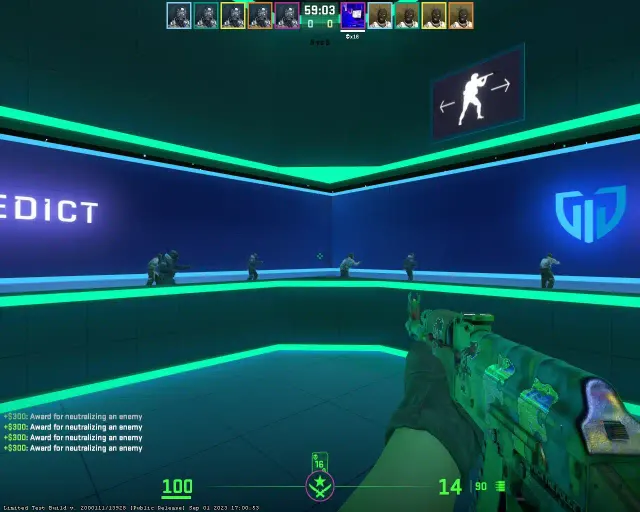
Play deathmatch with a focus on position, not kills. Instead of grinding for kills in DM, play it as a crosshair placement drill. Before every fight, consciously place your crosshair at head height at the spot you expect the enemy. Don’t worry about your KD — worry about whether your first shot was already on target.
Review your own demos. Watch back your deaths in demo review and specifically look at where your crosshair was when the enemy appeared. You’ll quickly notice patterns — maybe you consistently get caught with your crosshair too low on a specific angle
Something worth updating?
Spotted an outdated detail or something we should add?